An apartment fitness center is one of the highest-leverage amenities a property carries. Residents use it. Prospects tour it. Marketing photos lead with it. And almost every one we walk into is either underbuilt with cheap equipment that breaks in a year, or overbuilt with the wrong machines for the actual user load. After 25 years of selling and refurbishing commercial fitness equipment to apartment communities, HOAs, hotels, and corporate campuses across the DMV, here is the straight playbook for outfitting a multifamily fitness center the right way.
If you are a resident looking for equipment for your own apartment, scroll to the resident section near the bottom. The rest of this guide is for the property manager, HOA board, or developer making the call on the building's amenity gym. For the hospitality counterpart to this guide (limited-service, full-service, and upscale hotel fitness centers, with the franchise-inspector checklist for Marriott, Hilton, IHG, and Hyatt), read our hotel gym equipment guide. For the CrossFit affiliate counterpart (box opening kits, rack-and-rig brand picks, and the eight categories every box needs), read our CrossFit gym equipment guide. For the corporate counterpart (small office, mid-corporate satellite, and HQ campus tiers, with the 2-bid procurement and refurbished-vs-new 5-year math), read our office gym equipment guide.
Apartment gym equipment: the short answer for property managers
Quick answer
For most multifamily fitness centers, the right anchor is 2 to 4 commercial-grade treadmills, 1 to 2 commercial ellipticals, 1 to 2 upright or recumbent bikes, a functional trainer or selectorized strength station, an adjustable bench, and a set of dumbbells. The single biggest mistake is buying residential equipment to save money: a $1,500 home treadmill cycled by 80 residents will fail inside 12 months. A used commercial-grade treadmill at the same price will run for 8 to 10 years. The right move is commercial-grade equipment, ideally refurbished, sized to your resident count and unit type, with a maintenance contract attached from day one. Budget roughly $8,000 to $15,000 for a small property, $20,000 to $40,000 for a mid-sized garden community, and $60,000-plus for a luxury Class A fitness center.
The two kinds of apartment gym equipment buyers (and which one you are)
Quick answer
Most "apartment gym equipment" searches mix two very different buyers: residents outfitting a personal workout space inside their unit, and property managers outfitting the building's shared fitness center. The equipment, budget, and decision criteria for the two are completely different. This guide is built for the second buyer.
Residents buying for their own apartment care about noise, footprint, and not annoying the neighbor downstairs. They are usually shopping for one or two pieces that fit a corner of a living room. Property managers buying for the building's amenity gym are sizing equipment to a resident count, planning for 10-year lifespans, and balancing capital expense against the resident-retention value of a fitness center that actually works. Same search term, opposite buying decision.
If you are a property manager, HOA board member, developer, or asset manager outfitting a shared fitness center, this guide is for you. The full equipment list, budget tiers, and mistakes-to-avoid section all assume you are buying for a building amenity, not a single unit.
What a working multifamily fitness center actually needs
Quick answer
A working apartment fitness center has cardio (treadmills, ellipticals, bikes) sized to roughly 1 cardio piece per 30 to 50 residents, plus a strength station and free weights. Skip the gimmicks. Residents want machines that work, not 14 niche pieces that sit idle and clutter the floor.
Here is the equipment list that actually gets used in a multifamily fitness center, in priority order:
| Equipment | Why it earns its space | How many for a 100-200 unit property |
|---|---|---|
| Commercial treadmill | The single most-used piece in any apartment gym. Residents walk, run, watch TV. Always the first to wear out. | 2 to 4 |
| Commercial elliptical | Low-impact cardio for residents who cannot or will not run. High repeat use, especially in older demographics. | 1 to 2 |
| Upright or recumbent bike | Easiest entry point for older or less-fit residents. Recumbents especially work for rehab cases and seniors. | 1 to 2 |
| Functional trainer or cable machine | One station, 30+ exercises. Replaces a wall of selectorized machines in less square footage. | 1 |
| Adjustable bench | Needed for any free-weight or dumbbell training. Cheap, takes up almost no space. | 1 to 2 |
| Dumbbells (5 to 50 lb) | The most-used strength equipment after the cardio. A full rack covers 90 percent of resident strength training. | 1 rack |
| Stretching and floor area | Mats, foam rollers, and 6 by 8 feet of open floor. Costs almost nothing, used constantly. | 1 corner |
| Mirror wall, fans, water station, towels | The amenity layer that turns a room with machines into an actual fitness center. | 1 of each |
What we recommend against, almost universally for apartment fitness centers: stairmill or stair climber (cardio piece #4 at best, and a magnet for injury complaints), rowers (lower use than you expect outside of CrossFit-oriented buildings, and the chains need maintenance), specialized selectorized strength lines (six machines for the price of one functional trainer, and they sit idle), and any piece with screens that need WiFi credentials residents will not have. For deeper dives on the cardio pieces, see our commercial treadmill buying guide and commercial elliptical buying guide. For property managers buying used ellipticals specifically (the right tier for most apartment fitness centers), the used elliptical for sale buying guide covers model timelines, pricing tiers, and the inspection checklist. For the upright and recumbent bikes in the amenity mix, the used stationary bike buying guide covers what to buy.
Why commercial-grade equipment is non-negotiable in an apartment fitness center
Quick answer
A residential treadmill is rated for about 5 to 10 hours of use per week. An apartment fitness center treadmill in a 200-unit property sees 25 to 60 hours per week. Residential equipment in that load fails inside a year. Commercial-grade equipment is built for 100-plus hours per week and is the correct, only choice for a shared amenity gym.
The math is the entire argument. Residents do not know or care that the $1,500 NordicTrack you bought instead of a $3,000 used commercial Life Fitness will be broken in 11 months and replaced again 11 months after that. They just see a fitness center where the treadmill is always down. Two replacement cycles later you have spent more than the commercial unit and the building has a reputation for a broken gym.
| Residential-grade | Commercial-grade | |
|---|---|---|
| Rated weekly use | 5 to 10 hours | 100+ hours |
| Motor (treadmills) | 1.5 to 3 HP, often peak-rated | 3 to 4 HP continuous-duty |
| Frame | Light gauge steel, often welded thin | Heavy gauge welded steel, commercial chassis |
| Console / electronics | Consumer parts, often non-serviceable | Replaceable, parts available 10-plus years |
| Expected lifespan in an apartment gym | 6 to 18 months | 8 to 12 years |
| Replacement cost over 10 years | $10,000 to $20,000 per machine slot | $3,000 to $5,000 per machine slot |
The cheapest equipment is almost always the most expensive equipment over the life of the property. We sell against this exact mistake constantly. The full breakdown of the durability gap is in our used vs new commercial gym equipment guide, which makes the same point with bigger context.
Apartment fitness center budget tiers: small property, mid-sized, and luxury Class A
Quick answer
A small property fitness center (under 100 units) lands around $8,000 to $15,000 with refurbished commercial equipment. A mid-sized garden-style community (100 to 300 units) lands around $20,000 to $40,000. A luxury Class A high-rise fitness center runs $60,000 to $150,000-plus depending on whether you are doing a full studio package with cardio, strength, functional zone, group fitness room, and a Peloton wall.
These are the real ranges we see and quote across Northern Virginia, Maryland, and DC. The variable that moves the number is whether you buy new, lightly used, or refurbished commercial. Refurbished commercial usually lands at 60 to 85 percent off retail, which is exactly how a $40,000 mid-size fitness center build can come in at $15,000 to $20,000 with the same equipment quality.
| Tier | Property size | Equipment mix | Budget (refurbished commercial) | Budget (new commercial) |
|---|---|---|---|---|
| Small property | Under 100 units | 2 treadmills, 1 elliptical, 1 bike, 1 functional trainer, 1 bench, dumbbells | $8,000 to $15,000 | $25,000 to $40,000 |
| Mid-sized | 100 to 300 units | 3 to 4 treadmills, 2 ellipticals, 2 bikes, 1 functional trainer, 2 to 3 selectorized strength pieces, full dumbbell rack | $20,000 to $40,000 | $60,000 to $100,000 |
| Luxury Class A | 300+ units, high-rise, premium amenity positioning | 4 to 6 treadmills (with screens), 2 to 3 ellipticals, 2 to 3 bikes, full strength line, functional zone, group fitness studio, Peloton-style cycles | $60,000 to $150,000-plus | $150,000 to $400,000-plus |
The refurbished column is not a downgrade. It is the same brands (Life Fitness, Precor, Cybex, Matrix, Star Trac, Hoist, Nautilus) at 60 to 85 percent off retail, factory-rebuilt, tested, and warrantied. That is the actual outlet model and the reason most property managers we work with come back for their next property's build-out. Property managers handling refreshes across multiple buildings should also read our gym equipment wholesale guide, which breaks down the real bulk-pricing math at 10, 25, and 50-machine order tiers. For the lease versus outright purchase versus equipment loan math on the same buildout (with Section 179 treatment and the 5-year all-in cost numbers), read our commercial gym equipment lease vs buy guide.
The 7 mistakes property managers make outfitting an apartment gym
Quick answer
The expensive mistakes are residential-grade equipment in a commercial-load environment, too many niche pieces, no maintenance plan, ignoring flooring and ventilation, buying based on a glossy catalog photo, treating the fitness center as a one-time capital expense, and not asking who will service it in year 4. Avoid these and the rest of the build is straightforward.
- Buying residential equipment to hit a number. The single most common and most expensive mistake. Always commercial-grade in an apartment fitness center. See the table above for why.
- Too many niche machines, not enough of the right ones. A room with one of every piece is worse than a room with three good treadmills, two ellipticals, a functional trainer, and dumbbells. Residents queue for the things they actually use.
- No maintenance contract. A treadmill that goes down in month 14 with no service relationship in place sits broken for six weeks while you find someone who can fix it. Set up a quarterly service contract on day one with whoever supplied the equipment. Our equipment repair service covers the DMV for exactly this reason.
- Ignoring flooring and ventilation. Rubber flooring under cardio is not optional. It protects the slab, protects the equipment, and dramatically reduces the noise complaint count from the unit downstairs. Ventilation and a working AC unit matter even more in the summer; residents stop using a fitness center that runs hot.
- Buying from a glossy catalog photo instead of a showroom. A photo cannot tell you how a treadmill belt feels or whether the elliptical stride is right for older residents. Anyone buying $20,000-plus of equipment should be able to walk in and try it. That is exactly why our walk-in Purcellville showroom exists.
- Treating the fitness center as a one-time capital expense. A 10-year equipment plan with budget set aside for parts, belts, and the inevitable motor replacement saves the property far more than the initial discount on the cheapest gear. The fitness center is an ongoing operating cost, not a one-time line item.
- Not asking who services it in year 4. When a 7-year-old commercial treadmill needs a deck flip and a new belt, you need someone who can do that work without sending it back to a manufacturer. Always confirm parts availability and a local service tech before you commit to a brand.
25-year operator note
We have walked into apartment fitness centers where every single treadmill was a $1,200 NordicTrack from a big-box store, and every single one was either broken or limping. The property had spent $9,600 on six machines that all needed replacing inside 18 months. The same money, spent once on three refurbished commercial Life Fitness or Precor treadmills, would have given that property a working fitness center for the next decade. The "savings" on residential-grade is almost always more expensive than commercial within two years.
Maintenance, warranty, and lifecycle planning for a multifamily gym
Quick answer
Plan on quarterly preventive maintenance, a belt and lubrication service on treadmills every 12 to 18 months, and a parts and labor budget of roughly 10 percent of the original equipment cost per year. Commercial equipment with a 1 to 2 year refurbisher warranty and a local service relationship will run reliably for 8 to 12 years.
The maintenance plan should be set up before the equipment is delivered, not after the first machine goes down. Three things go into a working plan:
- Quarterly preventive maintenance visits. A tech walks every machine, lubricates moving parts, checks console error codes, tightens loose hardware, and flags pending issues before they fail. Costs roughly $250 to $600 per visit for a full multifamily fitness center.
- Belt and deck service on treadmills. Commercial treadmill belts last 12 to 18 months under apartment load before they need replacement or rotation. The deck can usually be flipped once before it needs replacing. Plan one belt and lube cycle per treadmill per year.
- Parts and labor budget. Budget roughly 10 percent of the original equipment cost per year for parts and outside-of-quarterly labor. A $30,000 build budgets $3,000 per year for ongoing maintenance, and that is enough for almost any issue short of a major motor failure.
A refurbisher warranty (typically 1 to 2 years parts and labor on the rebuilt machine) is the safety net for the first warranty window. After that, the local service relationship is what matters. Brands that have widely available parts in 2026 across the DMV: Life Fitness, Precor, Cybex, Matrix, Star Trac, Hoist, Nautilus, Paramount. Brands where parts are harder to source: most consumer-only brands and a handful of overseas builders.
Where used and refurbished commercial equipment wins for apartment fitness centers
Quick answer
Refurbished commercial equipment is the value sweet spot for multifamily fitness centers. Same brands, same chassis, same lifespan, at 60 to 85 percent off retail. The catch: "refurbished" only matters if it was actually refurbished. Buy from an outlet that brushes, sands, dresses, aligns, and tests every machine, with a written warranty.
A new commercial-grade fitness center build often runs three to five times the cost of the equivalent refurbished build, with identical residents and identical use. The difference is paperwork: a refurbished Life Fitness 95Ti treadmill is the same machine as a new one, just with a few thousand hours on the motor (which is rated for 30,000-plus). The refurbishment process is where the value either holds or evaporates. Real refurbishment is:
- Tear-down, deep clean, and inspection of every component
- Replacement of any worn or out-of-spec parts (belts, decks, bearings, rollers, cables)
- Frame brushing, sanding, and refinishing
- Console diagnostics and re-flashing where applicable
- Full alignment and calibration test under load
- Written 1 to 2 year warranty on parts and labor
"As-is" or "lightly tested" equipment is a different product entirely; we cover that distinction in our refurbished vs as-is gym equipment guide. For property managers, refurbished is almost always the right tier. As-is can work for a small budget if you have your own service tech and the right inspection skills (see our inspection checklist), but the warranty and tested-under-load aspect of refurbished is what makes the multifamily lifecycle math work.
For where to source the equipment in the first place (outlets vs dealers vs auctions), see our where to buy commercial gym equipment guide. For the brand-level decision, the best commercial treadmill brands of 2026 piece compares Life Fitness, Precor, Cybex, Matrix, and Star Trac side by side.
For residents: small-apartment workout equipment that does not bother the neighbors
Quick answer
For an apartment unit, the best low-noise, low-footprint picks are a magnetic-resistance exercise bike, a foldable rower, a set of adjustable dumbbells, an adjustable bench, and a pull-up bar that mounts in a doorway. Skip the treadmill in any upstairs unit; running on a treadmill carries to the unit below no matter what mat you use.
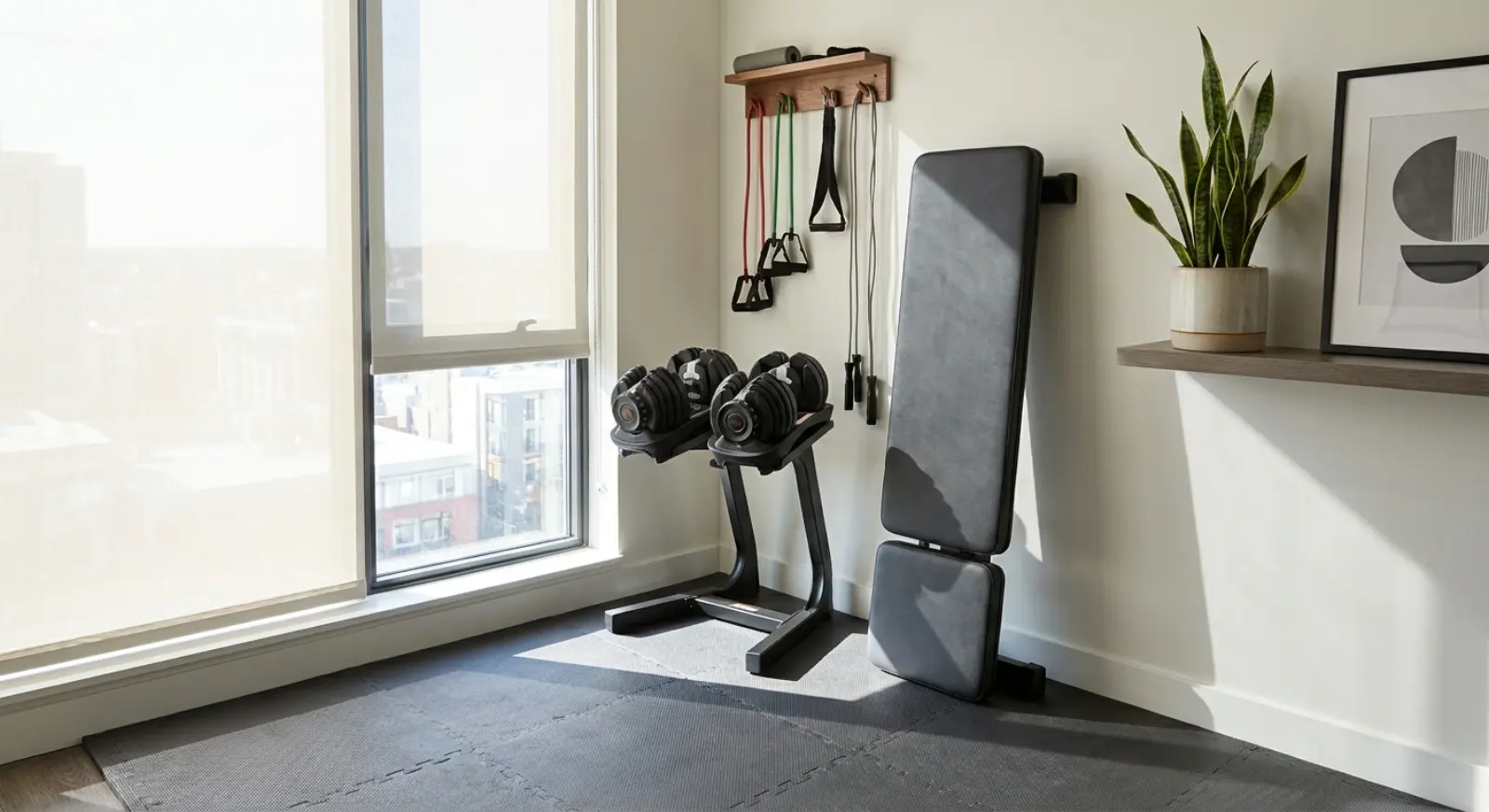
If you are a resident outfitting your own apartment workout space, the priorities flip. You care most about footprint, noise to the neighbor downstairs, and not putting the equipment somewhere it will not get used. A short shopping list that works in almost any unit:
- Magnetic-resistance exercise bike or indoor cycle. Quiet, compact, low-impact, easy on the floor. The best single piece for a small apartment.
- Foldable rower. A used Concept2 air rower is loud, but a magnetic rower is nearly silent and folds against a wall. See our used Concept2 rower guide if noise is not a concern.
- Adjustable dumbbells. Replaces a rack with one set of weights that adjust from 5 to 50-plus pounds. Same footprint as a bedside table.
- Adjustable bench. Folds flat, takes up almost no space, and unlocks a real strength workout when paired with dumbbells.
- Doorway pull-up bar. Costs nothing, takes zero floor space, and is the best upper-body builder per dollar.
- Skip the treadmill in an upstairs unit. Running impact travels to the unit below. If you must have one, look for a quiet commercial treadmill with full rubber decking and a thick mat, and run on it in the middle of the day. Better option: use the building's fitness center for running and keep the bike or rower in your unit.
If you are willing to invest in commercial-grade for your unit, the same logic that applies to a building amenity applies at home: a refurbished commercial bike or rower will outlast three residential ones and is often the same price as a new mid-tier consumer machine.
FAQs about apartment gym equipment
How much equipment do I need for an apartment fitness center?
Roughly 1 cardio piece per 30 to 50 residents, plus 1 to 2 strength stations and a dumbbell rack. A 100-unit property does well with 2 to 3 treadmills, 1 to 2 ellipticals, 1 bike, a functional trainer, an adjustable bench, and 5 to 50 pound dumbbells. A 300-unit property scales the same mix up by roughly 50 percent.
Can I use residential treadmills in an apartment fitness center?
No, and the cost difference is the entire reason. A residential treadmill rated for 5 to 10 hours of weekly use will see 25 to 60 hours of weekly use in an apartment gym and fail inside 12 to 18 months. A used commercial-grade treadmill at the same price will run for 8 to 10 years. Always commercial-grade.
What is the best commercial treadmill brand for an apartment gym?
Life Fitness, Precor, and Matrix are the three most common picks in 2026 for apartment fitness centers because they balance reliability, parts availability, and resale value. Cybex and Star Trac are also strong. The full brand comparison is in our best commercial treadmill brands of 2026 guide.
Should we buy new or used commercial equipment for the building?
For most multifamily properties, refurbished commercial is the value sweet spot: same brands and same chassis as new, at 60 to 85 percent off retail, with a 1 to 2 year warranty. New makes sense for luxury Class A properties where the marketing photo and warranty length matter as much as the equipment itself.
What is the typical lifespan of commercial gym equipment in an apartment fitness center?
Commercial-grade cardio runs 8 to 12 years with quarterly maintenance and one belt-and-lube cycle per year. Commercial strength equipment (functional trainers, selectorized stations) runs 15-plus years because there is far less to wear out. Residential equipment in the same use case runs 12 to 18 months before it needs replacement.
Do I need flooring for an apartment fitness center?
Yes. Rubber flooring under cardio protects the slab, protects the equipment, and reduces noise to the units below. Budget for the flooring as part of the build, not as an afterthought. Tiled rubber flooring is the easiest option for an existing space; rolled rubber is cleaner for a new-construction fit-out.
What is the maintenance cost per year for an apartment fitness center?
Plan on roughly 10 percent of the original equipment cost per year for ongoing parts and labor, plus quarterly preventive maintenance at $250 to $600 per visit. For a $30,000 equipment build, that is roughly $3,000 to $5,000 annually for parts, labor, and quarterly service.
Can I get a tour of equipment before buying for my property?
Yes, and you should. A showroom lets you try every machine before a 5 to 10 year amenity decision. Our Purcellville showroom carries 500-plus machines across Life Fitness, Precor, Cybex, Matrix, Star Trac, Hoist, and more, with DMV-wide delivery. See our wholesale page for property pricing and our commercial gym equipment near me DMV guide for the full local-sourcing playbook.
Bottom line: how to think about apartment gym equipment in 2026
An apartment fitness center is one of the highest-ROI amenities a property carries when it works, and one of the loudest resident complaints when it does not. The decision that determines which side you land on is made on day one: commercial-grade equipment from the start, sized to the resident count, with a maintenance plan attached, and ideally sourced refurbished to hit the budget without sacrificing the quality. Skip the residential shortcut, skip the gimmicks, and put the savings into the cardio pieces that residents actually use plus the maintenance contract that keeps them working in year 4 and year 7. For property managers wanting a quote or a showroom tour, the wholesale path is the right starting point. For the brand-by-brand and category-by-category buying calls, our treadmill buying guide and elliptical buying guide have the full breakdown.